How to Pack Fragile Items Without Breakage
A wine glass that survives the packing process can still break in the truck if the box has empty space, weak tape, or a heavy carton stacked on top. That is why knowing how to pack fragile items is less about using more bubble wrap and more about creating a stable, well-labeled system from the start.
For a local move across Melbourne or a longer relocation to Geelong, Ballarat, or regional Victoria, fragile packing deserves time and the right materials. Rushing this part of the move often leads to damaged glassware, chipped dishes, cracked mirrors, and a far harder unpacking day.
Start with the right boxes and materials
Fragile belongings need boxes that can hold their shape under weight. Reused cartons are fine only if they are clean, dry, have no crushed corners, and can be taped securely. A box that has softened from moisture or split along a seam is not worth the risk.
Choose small or medium boxes for dense items such as plates, books, stoneware, and glass. Large cartons can be useful for lampshades, cushions, and lightweight decor, but they become unsafe when filled with heavy breakables. If one person cannot lift a box comfortably, it is too heavy.
Before you begin, set aside packing paper, bubble wrap, strong packing tape, a marker, and sturdy boxes. You may also need cardboard dividers for glasses, corner protectors for framed art, and moving blankets for larger pieces. Avoid using newspaper directly against delicate surfaces, especially white ceramics or unsealed finishes, because ink can transfer.
How to pack fragile items one piece at a time
The safest packing method changes slightly by item, but the basic rule stays the same: wrap each piece, cushion the box, remove empty space, and keep the weight manageable.
Start by taping the bottom of every carton. Use several strips across the main seam, then run tape in the other direction if the box will carry plates, glass, or other dense items. Add a layer of crumpled packing paper to the bottom before placing anything inside. This creates a cushion if the carton is set down firmly.
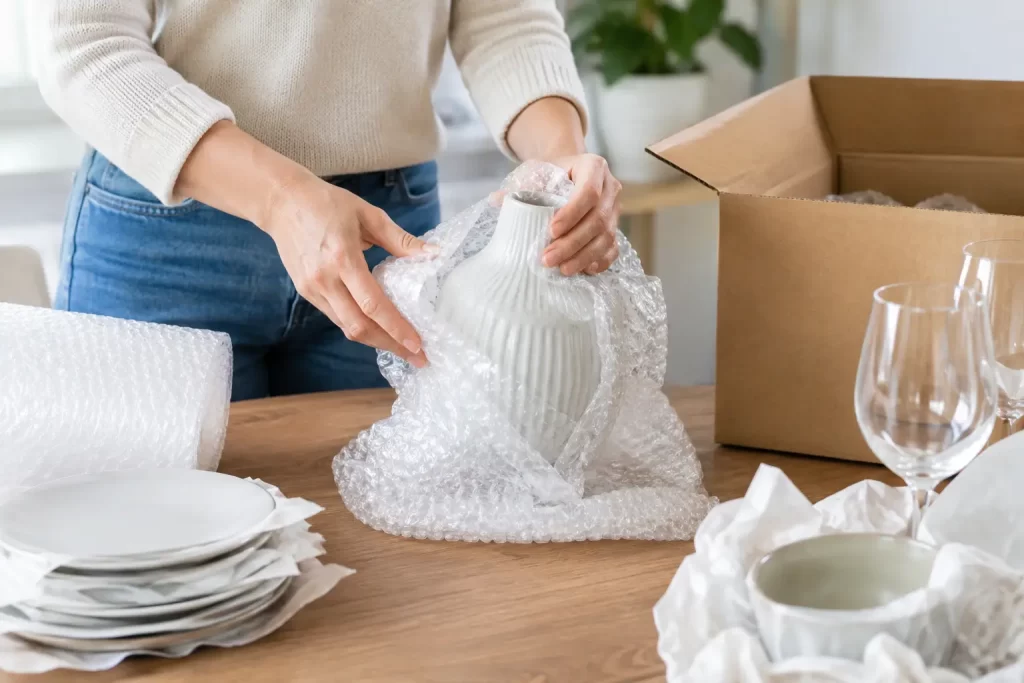
Wrap individual items rather than bundling loose pieces together. Lay glassware or ceramics on packing paper, fold one corner over the item, roll it forward, and tuck the sides as you go. Use extra paper around handles, spouts, lids, and thin stems. Bubble wrap is best saved for highly delicate pieces, electronics, framed items, and objects with sharp or uneven edges.
As you fill the box, place heavier wrapped pieces at the bottom and lighter ones at the top. Keep similar sizes together where possible. A box packed with random shapes creates gaps, and gaps allow movement. Fill every remaining space with crumpled paper, towels, or soft linens until the contents do not shift when you gently rock the closed carton.
Do not overfill the box. The flaps should close flat without force. A bulging carton is difficult to tape, difficult to stack, and more likely to split during loading.
Plates, bowls, and serving dishes
Plates are stronger when packed on their edges, much like records in a crate, rather than stacked flat. Wrap each plate separately, group a few similarly sized plates together, and place them vertically in a small, reinforced box. Put layers of cardboard between groups for extra support.
Bowls should be wrapped individually and nested only if there is cushioning between them. Serving dishes, platters, and casserole lids need extra protection along their rims and corners. Never leave a lid resting loose on its matching dish.
Wine glasses, mugs, and stemware
Stemware needs careful attention around the bowl and stem. Stuff a small amount of paper inside each glass, wrap the stem first, then wrap the full glass in several layers. Place glasses upright in a divided carton when available. If you do not have dividers, keep each wrapped glass separated with firm layers of paper and do not pack heavy items in the same box.
Mugs are sturdier than wine glasses, but handles remain vulnerable. Wrap the handle with extra paper and position mugs so they cannot knock together. A box marked fragile is not a substitute for tight packing inside the box.
Mirrors, artwork, and framed photos
Tape an X across the glass face using painter’s tape or packing tape applied carefully. This will not stop glass from breaking, but it can help contain pieces if an impact occurs. Protect the corners first, then wrap the entire frame with bubble wrap or a moving blanket and secure it with tape.
Keep framed items upright, never flat beneath other boxes. Larger mirrors and artwork should travel in a dedicated picture carton or be handled as a separate item by the moving crew. Tell the crew about valuable or unusually delicate frames before loading begins.
Lamps, electronics, and small appliances
Remove lamp bulbs, shades, and detachable parts. Pack lampshades separately in a large box with plenty of clean paper around them, but do not compress them. Wrap lamp bases individually and keep cords secured so they cannot scratch surfaces.
For electronics, original packaging is ideal if you still have it. Otherwise, photograph cable connections before unplugging, place cables in labeled bags, and wrap the device in anti-static material or clean bubble wrap. Avoid packing electronics in a box that may sit in extreme heat, moisture, or direct pressure from heavy furniture.
Label boxes for the people handling them
A clear label helps everyone make better decisions on moving day. Write the destination room on at least two sides of the carton, then add a specific description such as “Kitchen – wine glasses” or “Living room – framed photos.” Mark “FRAGILE” in large letters on the top and sides.
It also helps to add “THIS SIDE UP” when the orientation matters. Do not rely on a single top label because boxes are often turned during loading. If an item is high value or cannot be replaced, keep it with you where practical or point it out directly to the movers.
Load fragile boxes in the right order
Good packing can still be undone by poor loading. Fragile cartons should be loaded upright, secured so they cannot slide, and protected from heavy furniture. They should not be used to fill gaps under tables or stacked at the bottom of a tall column of boxes.
This is where an experienced moving crew makes a practical difference. Professional movers use truck placement, straps, blankets, and careful stacking to limit movement in transit. At House Removalists Melbourne, directly employed crews handle packing and removals without subcontractors, so there is clear accountability from pickup through safe delivery.
If you are moving yourself, keep fragile boxes close to the front of the truck or against a stable wall, with heavier non-fragile cartons low and away from them. Drive smoothly, allow more braking distance, and avoid leaving a loaded truck unattended in harsh weather where possible.
Common fragile-packing mistakes to avoid
The most frequent mistake is assuming a “fragile” label will protect a poorly packed box. Labels communicate care requirements, but they cannot prevent movement inside a carton. Another common problem is mixing heavy cookware with glasses or decorative pieces simply to use up space. Pack by weight and vulnerability, not just by room.
People also underestimate the importance of box condition and tape. A bargain carton is not a saving if it fails at the bottom of the stairs. Finally, avoid leaving packing until the night before a move. Fragile items take longer because each piece needs individual attention, and rushed wrapping usually means missed gaps and overloaded boxes.
For a large home, a tight settlement deadline, or belongings that need specialist handling, professional packing can be the safer option. The goal is not to make every box look perfect. It is to make sure every fragile item arrives stable, protected, and ready to unpack in one piece.